
Healthcare Performance Trends

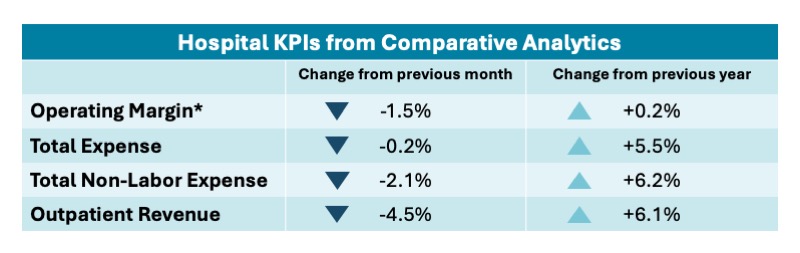
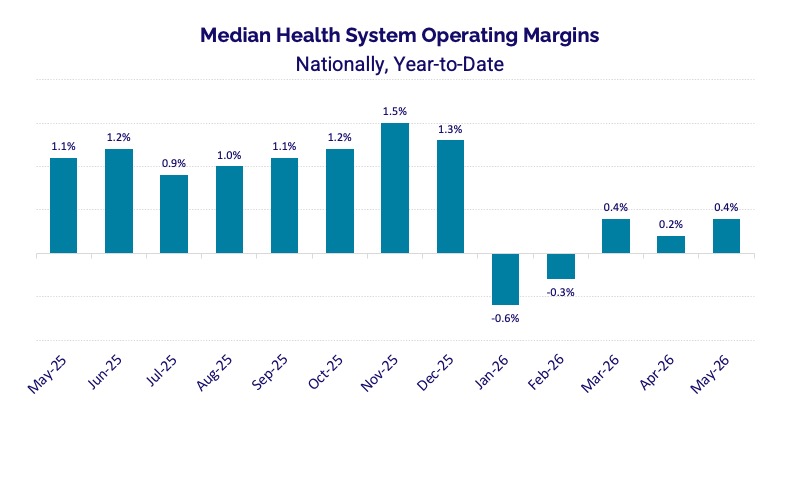
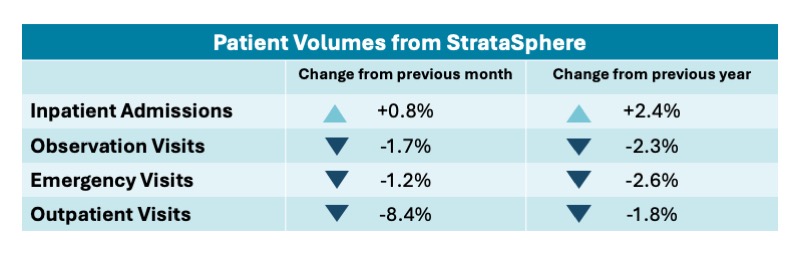
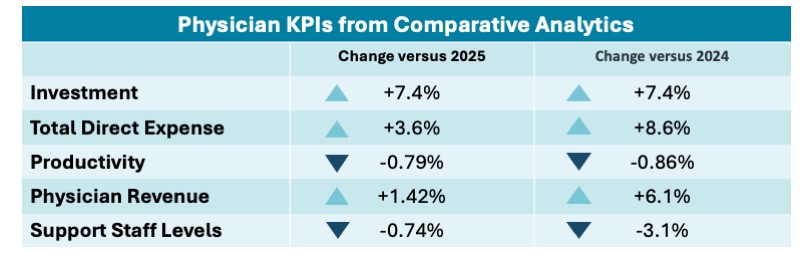
The Strata Performance Trends report combines financial, operational, and claims data from hospitals, health systems, and other healthcare organizations across the country. The data show that financial performance continued to lag in Q3 2025 as organizations experienced widening disparities by system size, patient acuity, and service line mix. 

Key findings include:

CFO Outlook for Healthcare

Financial performance stabilized for many healthcare organizations throughout 2024, and healthcare leaders are cautiously optimistic they’ll retain those financial gains in 2025. ​Our annual survey of healthcare finance professionals found that more than two in five (44%) said they expect operating margins will remain about the same from 2024 to 2025, while over a third (36%) expect operating margins will increase. 

2024 Higher Education Summit

Join peers, Strata experts, and industry leaders for two days of insightful sessions, and hear how healthcare organizations across the country are tackling today’s biggest challenges. Leaders from peer organizations will share best practices that will help you propel your organization’s financial planning, analytics, and performance processes.  

Operational Rigor as the Foundation for Recovery and Growth

 By Frank Stevens and Steve Wasson 

Over the past several years, health system leaders have spoken candidly about disruption, uncertainty, and recovery. At this year’s J.P. Morgan Healthcare Conference, Not-for-profit Track, the tone was notably different. Executives were explicit about moving beyond episodic cost-cutting initiatives to something deeper and more durable: operating rigor as the foundation for sustained performance, margin recovery, and long-term growth. 

As executives from the largest health systems presented their priorities for the year ahead, a common thread emerged. Organizations that are stabilizing and moving forward are not relying on one-time cost programs or isolated technology pilots. They are building disciplined and sustainable operating models, clear accountability, and repeatable execution supported by data, robust decision support systems, and increasingly, artificial intelligence (AI) embedded directly into workflows. 

This article concludes a three-part series in which Strata examines key themes from the conference alongside insights from our proprietary hospital and health system performance data and ongoing conversations with healthcare leaders across a range of organizations. 

From stabilization to disciplined execution 

Throughout the conference, healthcare leaders emphasized that recovery and financial stability only endure when operating rigor becomes the baseline. A health system based in the Midwest articulated a “flywheel” model of volume and mix improvement, capacity and cost discipline, and stronger commercial competitiveness reinforcing one another over time. Operating discipline was presented as the foundation and the permanent engine underlying all strategy across its multi-state service area. 

Leaders from another health system echoed a similar message, describing a disciplined financial turnaround and strategic reset that repositioned the organization from a loosely connected healthcare conglomerate into a focused, diversified healthcare system across seven states. Leaders highlighted a regimented operating cadence, including weekly one-hour operating reviews with the system’s top 75 leaders and dozens of tightly tracked workstreams spanning revenue, expense, access, and portfolio actions. The results were tangible, including a significant reduction in use of agency labor and sizable savings in shared services. 

Operational metrics matter because margins follow 

An analysis of Strata data shows some improvements in core operational metrics for hospitals nationwide. For example, median length of stay has remained stable at approximately three days over the past three years, indicating overall consistency in inpatient throughput and care delivery. Case mix index (CMI) has also been relatively stable in recent years, with median year-over-year changes hovering near 0% from 2023 to 2025, suggesting a stable acuity profile. In 2025, the median change in CMI was down 0.59%, reflecting strategic shifts toward lower-acuity outpatient care. 

At the J.P. Morgan conference, leaders consistently highlighted the importance of operating models, cadence, and accountability down to the supervisor level. Sutter Health described its transformation from a fragmented holding company into an integrated operating organization through a “ONE Sutter” model, built around a unified digital platform, consistent operating rhythm, and integrated capital planning.I Operating rigor is pushed deep into the organization, with “everyone knowing their numbers,” reinforcing an ingrained and continuous cycle of access, growth, margin, and reinvestment. 

Another health system similarly framed optimization as a core management discipline. Standardizing and simplifying operational processes were positioned as durable sources of savings and scalable performance improvement, enabled by technology modernization and a unified operating backbone. 

AI moves from experimentation to outcomes 

One of the most striking shifts at this year’s conference was how leaders talked about AI. Just a few years ago, AI was framed largely as pilots and proofs of concept. In 2026, it is increasingly described as embedded infrastructure producing measurable outcomes. 

Strata’s data reflect this shift. The percentage of health systems listing roles that include AI in the job description more than doubled, while the average number of AI full-time equivalents per system more than tripled over the same period. These roles span management and frontline functions, from analysts and project managers to vice presidents and chief officers, signaling institutional commitment rather than experimentation. 

Health systems provided concrete examples. Intermountain Health highlighted AI tools embedded into its electronic health record environment, including AI-enabled triage of tickets.II Leaders from Cleveland Clinic described AI as infrastructure across three domains: patients, caregivers, and enterprise operations, supported by deep technology integration and partnerships. The health system’s partnership with Palantir Technologies, for example, enables caregivers to leverage AI to better view, manage, and forecast bed availability, patient demand, staffing, and operating room scheduling.III 

Inova Health System presented AI as operational connective tissue. Leaders highlighted an AI-enabled call center handling over 300,000 calls per month, with half of appointment changes managed autonomously, unlocking more than 4,000 labor hours monthly and delivering an eight-times return on investment.IV 

Executives from another health system positioned AI as a core engine for clinical excellence, research acceleration, and education. The organization is using AI in a wide range of applications, including to support precision oncology and early cancer detection, and helping to build care planning models to drive clinical workforce efficiencies. 

Performance improvement as a permanent capability 

Another consistent theme was the reframing of performance improvement itself. Leaders repeatedly rejected the idea of episodic cost cutting in favor of performance improvement as a permanent organizational capability. 

One health system, for example, emphasized its repeatable global operating model and codified management system. Another health system’s focus on execution cadence, KPI transparency, and portfolio discipline reinforce the same principle: improvement is continuous, governed, and embedded in leadership routines. 

Median Percentage ChangeThis shift places renewed focus on effective performance management and decision support systems. As operating complexity increases and AI becomes more deeply integrated, healthcare leaders need real-time visibility into operational performance and clear accountability for action. Technology advancements were consistently framed as foundational enablers of simplification, standardization, and scalable execution. 

Median Percentage Change NORWhile definitively identifying cause and effect in complex systems is difficult, a high-level comparison of organizations that use benchmarking tools versus those that do not seem to support the importance of having rigorous operating processes. An analysis shows that health systems that used a benchmarking solution to routinely monitor and compare key performance metrics saw greater improvements over time in operating margins, total expenses, and productivity in recent years versus their peers. From 2023 to 2025, for example, health systems that used a benchmarking solution saw median change in operating margin increase 1.4 percentage points compared to an increase of just 0.7 percentage point for health systems that did not. Similarly, health systems that used benchmarking saw median change in total expense as a percent of system net operating revenue decrease 1.9% over the two-year period versus a 1.2% decrease for non-users. 

Perhaps the most significant change came in the form of productivity. Health systems that use benchmarking saw median percent change in worked hours per adjusted patient day decrease 1.0% from 2024 to 2025 versus a 1.8% increase for non-users over the same period. 

Results will always vary by entity, but these analyses suggest that healthcare leaders that use benchmarking tools appear to be more effective at driving meaningful operational improvements for their organizations. 

Rigor as the platform for growth 

Taken together, the message from the J.P. Morgan Conference was clear. Operational rigor is essential for growth. Systems that are improving access, optimizing capacity, and embedding disciplined execution are creating the financial and organizational flexibility to reinvest, pursue strategic acquisitions, and expand into new care models. 

Healthcare leaders repeatedly emphasized the need to build durable operating engines where data, accountability, and AI reinforce one another. In a sector still facing structural pressure, operational rigor has become the most reliable source of resilience and the clearest path to sustainable growth. 


i Sutter Health: 2024 Annual Report: Momentum with Purpose. August 2025. 

ii Bresnick, J.: “Responsible AI Governance Is Helping Intermountain Face the Headwinds.” DHI Insights, Oct. 17, 2025. 

iii Cleveland Clinic: “How AI Assists with Staffing, Scheduling, and Once-Tedious Tasks.” Feb. 14, 2024. \

iv Hyro: “Inova Health Hits 8.8x ROI with 100% Coverage of Patient Access Calls in First 6 Months.” 2025. 


Explore other healthcare data resources


How Health Systems Are Getting More Discriminating About Growth

By Frank Stevens and Steve Wasson 

The annual J.P. Morgan Healthcare Conference has long served as a bellwether for where the sector is headed, offering a concentrated look at the strategies, priorities, and pressures shaping the nation’s largest health systems. At this year’s conference, leaders from nearly every organization emphasized ambulatory growth relative to other types of care settings, ambulatory surgery center (ASC) expansion, and deliberate site-of-care shifts as central to their strategies for growth, access, and affordability. 

Across presentations for the conference’s not-for-profit track, what stood out was not simply the direction of travel, but the degree of commitment. Ambulatory and ASC strategies are no longer framed as incremental improvements or pilot programs. They are positioned as primary engines of growth, explicitly tied to margin resilience, consumer access, and long-term affordability. Leaders said this shift is being pursued with greater discipline than in the past, supported by targeted capital allocation and, in some cases, via selective partnerships. 

This is the second of three articles in which Strata explores key conference themes, combined with insights from Strata data and our ongoing conversations with healthcare executives nationwide. 

From expansion to selectivity 

If there was one unmistakable throughline at this year’s conference, it was selectivity. The largest health systems (and those that can afford to do so) are becoming far more discriminating about where they invest, where they grow, and where they pull back. Growth strategies are increasingly shaped by four interconnected priorities: 

  • Ambulatory and ASC expansion as the core growth lever 
  • Optimizing services provided and the locations in which they are provided 
  • Heightened discipline around capital allocation 
  • Fewer, but more intentional, partnerships 

Together, these priorities signal a sector moving from expansion to optimization, using site of care as a strategic lever. 

Of course, ambulatory expansion itself is not new. Health systems have invested in outpatient care, ASCs, and other non-hospital settings for more than a decade. What felt different this year was the way leaders talked about those investments. The language shifted away from growth for growth’s sake and toward ensuring strategic alignment of healthcare services. Executives described a deliberate restructuring of delivery models in which the most complex, resource-intensive care is concentrated within inpatient facilities, while lower-acuity care is systematically migrated to lower-cost, more convenient settings. This is not a change in direction so much as it is an acceleration and refinement of strategies that many systems have been building toward for years. 

Ambulatory and ASCs become the growth engine 

This emphasis aligns with trends seen across healthcare, as volume and revenue continue to migrate away from inpatient settings toward outpatient and ASC environments. The cost structure differences remain significant, with ambulatory settings carrying significantly lower fixed costs than acute facilities. For example, the average fixed cost for a primary hip replacement procedure in an outpatient setting is approximately 48% lower than the same procedure in an inpatient setting, while the average fixed cost for a primary knee replacement procedure is approximately 38% lower, according to Strata’s proprietary data. The average total costs for such procedures have steadily increased across all care settings in recent years. The average total cost for an inpatient primary hip replacement was $19,316 in 2025, up from $14,475 in 2022. The average total cost for the same procedure in an outpatient setting was $12,633 in 2025, up from $10,020 in 2022. 

Procedure Average Cost


Encounters Percentage

Proposed site-neutral payment policies further reinforce the need to shift care to outpatient settings, as they would equalize Medicare reimbursements for the same medical procedures regardless of where they are performed. To illustrate the difference, a Strata analysis shows that the average total cost margin for a primary hip replacement through Medicare was a loss of $725 for inpatient versus a positive $909 for outpatient in 2025. 

Margin contribution is increasingly tied to ambulatory growth, particularly in procedural and specialty service lines. At the J.P. Morgan conference, leaders were explicit that ambulatory platforms are more than feeders to hospitals; in many markets, they are now the front door to the system. 

Encounters Percentage per Region

This logic extends beyond access and convenience to the core operating model of health systems. Leaders indicated that inpatient facilities should be reserved for the most complex care, while lower-acuity services should move to settings better aligned with their resource needs. Strata data reinforce this view. Analysis shows that the number of ASC patient encounters per facility increased by 20% from 2022 to 2025. Regional variation was notable, with the Northeast experiencing the fastest growth at 29%, compared to increases of 17% in the South and West and 16% in the Midwest. 

Procedure-level shifts tell a similar story. Looking at orthopedic procedures across all settings, the share of those procedures performed in ASCs grew from 21% to 28% between 2022 and 2025. The share of orthopedic procedures performed in hospital outpatient departments, inpatient settings, and office clinics all declined over the same period. For gastroenterology procedures, ASC share increased from 55% to 65% from 2022 to 2025, accompanied by steady decreases across hospital outpatient, inpatient, and office-based settings. 

How leading systems are executing the shift 

Several organizations illustrated this approach. Leaders from one major health system described an ongoing portfolio transformation that reduces its acute care footprint while expanding ambulatory access and horizontal platforms. This strategy is paired with a deliberate effort to concentrate higher-acuity care within remaining hospitals. Horizontals were framed as managed growth businesses, not ancillary assets, with dedicated leadership, capital allocation, and performance expectations. 

Ascension’s acquisition of AMSURG, an ASC development and management company, is a centerpiece of the health system’s ambulatory strategy. The deal, announced in mid-2025, adds more than 250 ASCs across 34 states to Ascension’s network, providing national ASC scale while creating a platform for broader ambulatory adjacencies.I 

Leaders from Sutter Health highlighted ambulatory density as a core strategic advantage, particularly in high-cost markets. The health system is actively expanding its footprint, with well over $1 billion for more than 20 ASCs projects underway last year, and more planned for 2026.II 

Hartford HealthCare leaders framed the organization as a consumer-centric ecosystem that is moving care out of hospitals and into communities, with a strategy that emphasizes access, affordability, and quality. Its “house with 1,000 doors” model spans urgent care, ASCs, emergency centers, virtual platforms, and partnerships, such as its primary care partnership with Amazon One Medical and urgent care partnership with GoHealth.iii 

Capital discipline and partnerships go hand in hand 

Health system leaders repeatedly referred to renewed focus on capital discipline, describing investing and rationalizing at the same time, deploying capital where returns are clear while exiting or divesting assets that fail to create value. Strata’s regular conversations with healthcare executives across a range of organizations reflect this selectivity, with capital increasingly flowing toward ambulatory, outpatient, and technology investments, while acute spending is more tightly focused on maintenance, modernization, and targeted high-acuity capabilities. 

Partnerships are seen as a critical enabler of this strategy. Organizations spoke about leaning into partnerships that accelerate scale or capability, while exiting those that fail to create value. Examples ranged from Hartford HealthCare’s collaborations with GoHealth,iv Amazon One Medical,v and K-Healthvi to Hackensack Meridian Health’s relationships with Memorial Sloan Kettering,vii One Medical,viii Google,ix and CLEAR,x among others. Intentionality was a common theme. Partnerships are increasingly used to extend reach, speed market entry, or access capabilities that would be inefficient to build alone. There also was recognition that organizations can spread themselves "too wide" over too many partnerships, causing some organizations to narrow the number of partnerships they are engaged in to focus on those that bring the highest value. 

What this signals for the year ahead 

Beyond the J.P. Morgan conference, Strata’s conversations with healthcare leaders suggest a growing divide between large, diversified systems and smaller community hospitals. Many of the strategies highlighted at the J.P. Morgan conference require optionality — the ability to rebalance portfolios, exit markets, and shift volume and acuity across sites of care. Smaller hospitals often lack this flexibility. They carry a disproportionate share of fixed costs, face tighter capital constraints, and have fewer levers to pull as care continues to migrate out of inpatient settings. As large systems become more discriminating, the strategic gap between those with portfolio flexibility and those without may continue to widen. 

Across organizations of all sizes, however, growth is about designing portfolios that align capital, access, and margin. 


i Ascension: “Ascension Enters Into an Agreement to Acquire AMSURG.” News Release, June 17, 2025. 

ii Newitt, P.: “Inside Sutter Health’s Bold ASC Strategy.Becker’s ASC Review, March 13, 2025. 

iii Bruce, G.: “‘We Have to Disrupt Ourselves’: Hartford HealthCare’s Virtual Strategy.Becker’s Health IT, March 20, 2025. 

iv Hartford HealthCare: “GoHealth Urgent Care and Hartford HealthCare Partner to Deliver More Accessible, Patient-First Urgent Care in Connecticut.” News release, Jan. 16, 2017. 

v Amazon One Medical: “Hartford HealthCare and One Medical Announce Collaboration Focused on Seamless Coordinated Care.” News release, Feb. 23, 2022. 

vi Businesswire: “Hartford HealthCare and K Health Partner to Re-imagine Primary Care Delivery.” Feb. 21, 2025. 

vii Memorial Sloan Kettering: Coming Together to Do More: Memorial Sloan Kettering and Hackensack Meridian Health Are Committed to Making an Impact. Webpage accessed February 2026. 

viii Hackensack Meridian Health: “Hackensack Meridian Health and One Medical Announce Partnership Focused on Expanding Access to Care and Seamless Coordination Between Primary and Specialty Care.” News release, Nov. 14, 2023. 

ix Diaz, N.: “Hackensack Meridian to Deploy Google-Powered AI Agents.” Becker’s Health IT, Oct. 16, 2025. 

x Hackensack Meridian Health: “Hackensack Meridian Health and CLEAR Partner to Bring Secure, Seamless Digital Identity to the Patient Experience.” News release, Aug. 18, 2025. 


Explore other healthcare data resources


The Duality of Workforce Stabilization

By Frank Stevens and Steve Wasson 

After years of volatility, hospitals and health systems nationwide are seeing signs of workforce stabilization. That was a consistent theme at this year’s J.P. Morgan Healthcare Conference, Not-for-profit Track. Every year in January, healthcare leaders from across the industry converge on San Francisco to hear how the nation’s largest health systems are responding to emerging industry challenges and opportunities. The high-energy event provides a wealth of valuable insights, as top health system leaders share their organizations’ latest performance data and strategic priorities for the year ahead. 

This article is the first in a three-part series in which Strata explores key takeaways from the conference, combined with findings from our proprietary hospital and health system performance data, and learnings from ongoing discussions with healthcare executives from a broad range of organizations. 

At the J.P. Morgan conference, C-suite leaders touted trends of enhanced employee retention and engagement, a reduced reliance on contract labor, and more consistent staffing models. In addition to these operational wins, leaders emphasized that a more stable workforce underpins better care delivery and stronger financial performance. 

Yet, while greater workforce stabilization is helping moderate many pressure points, it does not necessarily equal relief. While overall non-labor expense growth outpaced labor expenses throughout 2025, labor costs continue to rise and remain a dominant pressure for health systems nationwide, according to Strata data from more than 1,850 hospitals nationwide. The result is a dual reality: organizations are better staffed and less dependent on premium labor but, at the same time, the costs associated with maintaining that stability in an intensely competitive labor market continue to rise. 

Stability gains and the cost trade-off 

Health systems have made clear progress in shifting away from their reliance on contract labor, which spiked due to widespread shortages during the COVID-19 pandemic. Use of contract labor and related expenses has declined significantly in recent years, as shown by Strata data. From 2023 to 2025, median contract hours per adjusted patient day decreased 29% for health systems nationwide, while contract labor expense per adjusted patient day dropped 31% over the same period. 

At the same time, worked hours per adjusted patient day have remained relatively stable. This dynamic suggests that contract hours have largely shifted back to employed staff, without a measurable change in labor efficiency in either direction. 

Benefits and Wages


However, the financial benefit of this shift has been muted. Total labor expense continues to climb as organizations reinvest savings from reduced contract labor into higher wages, benefits, and retention incentives for employed staff. Median health system wages paid to non-contract workers increased 7% and benefits expense per adjusted patient day rose 12% from 2023 to 2025, according to Strata data. 


Median Percentage Change


While such expenses rose for all health systems, the pace of increases varied by organization size. For example, benefits expense per adjusted patient day rose 2% over the two-year period for health systems with a net operating revenue (NOR) less than $300 million, but 11% for those with NOR of $300 million to $1 billion, and 16% for those with NOR greater than $1 billion. 


In Strata’s discussions with healthcare leaders, executives cite these rising costs as a significant concern, with some reporting multiple consecutive years of wage hikes as high as 6% per year, contributing hundreds of millions of dollars in added expenses. One leader noted the structural imbalance succinctly, saying his organization faced “2% reimbursement increases versus 7% pay raises.” 

This dynamic is reflected broadly across the industry. In Strata’s latest annual survey of hospital and health system finance leaders, roughly half of respondents identified labor as one of their top two concerns heading into 2026. 

Workforce stability as a care and performance strategy 

Despite ongoing expense pressures, the strategic case for workforce stabilization is stronger than ever. Throughout the J.P. Morgan conference, leaders consistently tied staffing stability to quality, safety, and enhanced operational performance. The conviction was clear: stable teams deliver better care. 

Leaders from numerous health systems shared recent strides in workforce stability. A Midwest-based health system described talent as its “primary differentiator,” a philosophy the health system supports through sustained investment in compensation, development, and enhancing the workplace environment. The organization reported that employee net promoter scores have doubled over three years, while average tenure is now three to four times that of industry norms. 

Others emphasized the role of technology in reinforcing workforce stability. One health system reported more than a million hours saved in 2025 through digital and artificial intelligence (AI)-enabled efficiencies, alongside declines in contract labor, overtime, and full-time equivalents (FTEs) per adjusted occupied bed as case mix complexity increased. Leaders from another health system highlighted the organization’s electronic health record (EHR) system migration, ambient documentation, and AI-driven workflow tools as part of a broader commitment to automate administrative burden wherever possible by 2028. 

Right-sizing, productivity, and governance 

In Strata’s annual survey, finance leaders ranked reducing costs and improving productivity measurement among their top priorities for 2026. Respondents pointed to better productivity reporting, more effective use of labor benchmarks, and real-time, shift-level productivity analysis as the most impactful strategies for managing labor expenses. 

In Strata’s regular meetings with hospital and health system leaders, executives say they are focused on “right-sizing” the workforce. Organizations are recalibrating staffing models post-COVID, with greater emphasis on position control and productivity governance. While contract labor costs have come down, productivity variation, premium pay, and recruitment challenges remain structural issues. 

Leaders acknowledge cultural barriers. Productivity data is widely viewed as essential but often under-trusted, with resistance rooted in concerns about fairness, context, and clinical autonomy. Overcoming that resistance will require not just better analytics, but clearer governance, transparency, and alignment between operational leaders and frontline teams. 

Long-term strategies in a constrained market 

Labor remains the dominant cost driver for hospitals, accounting for approximately 56% of total hospital expenses.i As such, it will always be at the forefront of health system improvement strategies. Looking ahead, executives stressed a need to invest in long-term workforce supply strategies, including education and training pipelines. For example, WellSpan Health partnered with Jersey College to establish a nursing school in southern Pennsylvania with the goal of helping to address workforce shortages.ii 

Recent moves toward stabilization have delivered meaningful benefits in care quality, engagement, and operational consistency for many health systems. At the same time, rising wages and benefits have locked labor costs into a structurally higher baseline, demanding more disciplined productivity management and governance. Healthcare leaders also are increasingly shifting their focus on labor beyond clinical settings, emphasizing a need to reduce corporate services spend, optimize spans of control, and relentlessly prioritize how they are investing in talent. 

For healthcare leaders, the challenge in 2026 and beyond will be navigating this duality: sustaining a stable, engaged workforce while rigorously managing labor productivity and expenses. Those that succeed will not treat labor solely as an expense to be contained, but as a strategic asset that requires data-driven oversight, cultural alignment, and long-term investment. 


I The American Hospital Association: The Cost of Caring: Challenges Facing America’s Hospitals in 2025. April 2025. 

II WellSpan: “WellSpan Health Partners with Jersey College to Establish a School of Nursing.” The WellSpan Spotlight, June 11, 2024. 


Explore other healthcare data resources


Healthcare Solutions Showcase

Learn more about Strata solutions and preview the latest functionality in short product presentations.

Topics by month:

• January - StrataJazz platform

• February - StrataJazz Labor Suite

• March - StrataJazz Revenue Analytics Suite

• April - StrataJazz Predictive Analytics

• May - Strata's Data Platform • June - StrataJazz Planning Suite

• July - TBD • August - TBD • September - TBD

• October - None. Attend the Summit!

• November - TBD • December - TBD