
Healthcare and Hospital Budgeting: A Complete Guide

The Basics of Healthcare Budgeting and Capital Budgeting


What is a budget in healthcare?

A healthcare or hospital budget is an estimation of revenue and expenses over a specified timeframe. Through the healthcare budgeting process, health systems come to an understanding of how much funding must be planned in certain areas, including operating costs and capital equipment. A health system may include hospitals, physician groups, skilled nursing facilities, home care services, foundations, and a variety of other business types. During the budgeting process, leaders must account for key components of planning in healthcare, including volume growth assumptions, feedback and input from key stakeholders, and the ability to adjust when inputs and circumstances change. Ultimately, a well-planned budget allows health systems to plan appropriately for the future in order to provide quality care.


What are the types of budgeting in healthcare organizations?

There are several types of budgets and planning processes in healthcare:

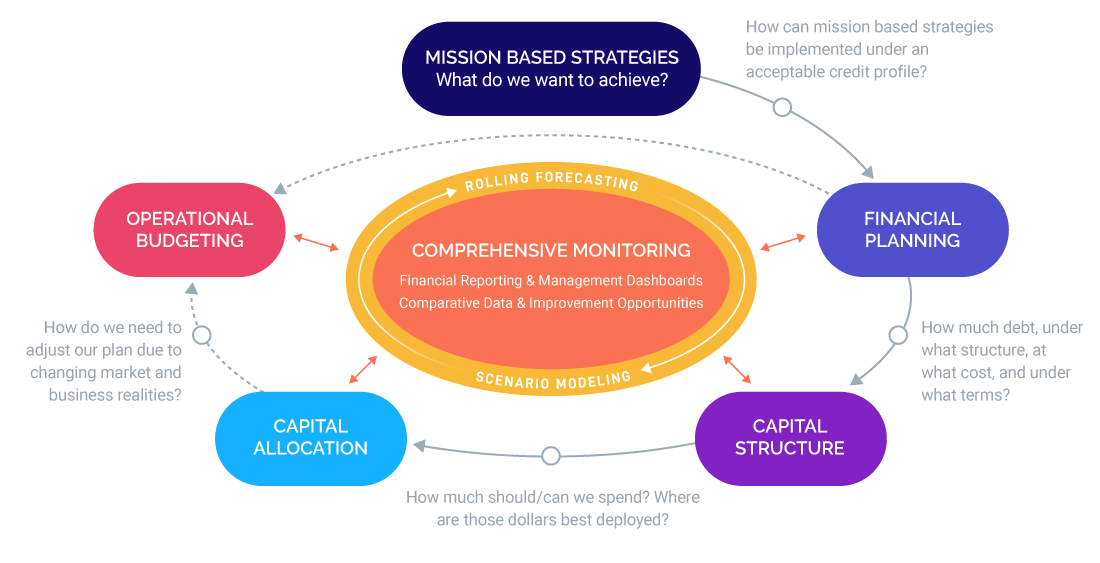
  • Operational budgeting in healthcare is the process of determining the funding planned for facility operating costs and personnel costs, such as staffing and training. Staffing is usually the largest cost in a healthcare operational budget, and it must not only account for fixed costs, like salaries, but overtime hours, potential overstaffing, and other variable costs. A healthcare operational budget allows hospitals and health systems to monitor and balance revenues and expenses.
  • Capital budgeting in healthcare is the process of allocating funding to the purchase of durable goods, such as beds, equipment, or improvements to buildings or infrastructure. A hospital capital budget is important because the purchases made from this pool of resources (e.g., more surgical equipment or updated technology) can have a direct impact on a health system’s ability to provide better care to more patients. Capital budgeting in healthcare is generally related to the hospital or health system’s overall strategic vision for the organization.

    When comparing an operating budget to a capital budget, it’s important to note that while the two are separate, each influences the other. Capital investments, such as new facilities or updated technology, can impact future staffing and operating costs. Funding for those purchases, however, may need to come from the operating budget. When planning hospital budgets, leaders must balance the effects of the two budgets.
  • Rolling forecasting in healthcare is a process for healthcare leaders to update their financial projections on a monthly or quarterly basis. This process uses historical data to continuously update near- and long-term projections. With frequent updates, leaders can adjust their strategy as conditions change. By utilizing rolling forecasting, healthcare organizations can plan more efficiently and make agile, data-driven decisions.


Why is budgeting important in healthcare?

Healthcare is a rapidly changing industry that must continuously adapt as new patient needs emerge, technologies and techniques are updated, and reimbursement models evolve. A strong healthcare budgeting process allows leaders to plan for the future and establish priorities around care and clinical departments. A healthcare budget is an important tool to understand where funds are best spent and how to allocate capital among various departments and projects. This enables healthcare organizations to be more efficient in delivering effective and efficient patient care.


What are the benefits of budgeting in healthcare?

Healthcare budgeting is critical for decision-making across health systems and organizations. An effective budget process allows healthcare leaders to:

  • Align operational plans with financial planning targets
  • Prioritize capital investments to align with strategic initiatives
  • Effectively manage capital spend and cash flow
  • Better understand the allotment of funding to individual projects, initiatives, and clinical departments
  • Minimize purchasing errors


What budget-related challenges do hospitals face?

Because of the rapidly changing nature of the healthcare industry, health systems and hospitals face many budget-related challenges, including:

  • Unpredictable economic events, such as the 2020 COVID-19 pandemic, which can render static budgets outdated and inaccurate
  • Changes to reimbursement and payment models, including declines in Medicare and Medicaid reimbursement
  • Development and adoption of new technologies, such as telehealth and home-based medicine
  • Labor shortages and increasing costs
  • Mergers, acquisitions, and increasing market competition from new care delivery models
  • Supply chain issues and interruptions, such as personal protective equipment (PPE) or prescription drug shortages


What factors affect a healthcare budget?

Beyond factors within a health system’s control, a variety of external factors can affect a healthcare budget, including:

  • Changes in patient volumes across various departments, which can affect service line budgeting
  • Rising interest rates
  • Inflation
  • Higher capital acquisition costs

The budgeting process in healthcare


The process of healthcare budgeting differs based on your planning approach, be it traditional budgeting or rolling forecasting.


Traditional budget

The traditional healthcare budgeting process typically involves budgeting software that incorporates historical data, inputs, and assumptions. Healthcare leadership reviews relevant data in the system from across all clinical services and departments.

The budget is then routed for input, updates, and approval from a variety of stakeholders. Ultimately, this process results in a budget that applies to a static period of time (such as a calendar year, Jan. 1 through Dec. 31).


Rolling forecasting

Rolling forecasting is a planning approach that allows healthcare leaders the flexibility to use historical data to predict future performance. Essentially, it answers the question, “How has the previous month or quarter changed our view of the present and future?”.

Unlike a traditional budget, which is based on static, annual data, rolling forecasts use current data to update near- and long-term projections. Based on rolling forecasts, leaders can quickly adjust strategy as financial conditions change, examine current expenditures and initiatives, and make strategic decisions about future endeavors.

Here’s how the process generally works:

  1. Budget process participants come together each month or quarter to assess and update the organization’s financial performance
  2. Participants select the appropriate forecast horizon (e.g., monthly or quarterly periodic forecasts for the current year and up to two years forward)
  3. Using the most recent data available, comparative and trend analyses are performed, often taking multiple scenarios into account. For example, to analyze the forecast for sensitivity and risk, organizations typically test against at least three sets of conditions, with favorable, unfavorable, and very unfavorable outlooks
  4. Based on these analyses, leaders evaluate key actions their organization should take now and in the short- and long-term to strengthen and protect the organization’s performance

With this process, leaders can create forecasts for six to 12 quarters, rather than only 12 months.


Best practices for the healthcare budgeting process

To avoid common budgeting struggles, healthcare organizations can simplify the planning process with these tips:

  • Create a budget calendar that shows the major tasks that need to be addressed during the process, who’s responsible, and major deadlines
  • Set realistic deadlines
  • Strive for continual improvement, documenting insights and enhancements that can be applied during the next planning cycle
  • Develop a timely monthly variance analysis process
  • Keep reporting simple for new users, first offering a smaller set of basic reports, and then providing more offerings as your leaders’ comfort levels increase
  • Give experienced users deeper insights, such as reports for individual departments on total revenue, operating income, expenses, salaries, and supplies, on both a current month and year-to-date basis
  • If you have an automated planning solution, keep it updated to ensure access to the latest features, enhancements, and dashboards

A Flexible, Forward-Looking Approach to Healthcare Budgeting


Axiom™ Budgeting software incorporates best practice budget methodologies designed to support efficient, accurate, and transparent budget development. It integrates with all major enterprise resource planning (ERP) systems and can be incorporated with your existing financial planning and analysis (FP&A) process. With Axiom Budgeting, healthcare leaders can easily model the impacts of volume, rate, and efficiency assumptions across revenue and expense plans with multiple versions or scenarios. Create an accurate and transparent budget utilizing integrated internal and external benchmarking data, as well as information from the general ledger, payroll, hospital/physician billing, and other systems.

Axiom™ Rolling Forecasting allows for the integration of rolling forecasts with long-term financial plans to support strategic and tactical planning success. Multiple configurations and settings support a monthly or quarterly forecast spanning up to 12 quarters or 36 months.

Hobson & Company, a third-party research organization focused on total cost of ownership and ROI studies, found that Axiom FP&A suite delivered:


75% less time reconciling data and creating budgets
+
75% faster budget reporting

MORE HELPFUL RESOURCES ON HEALTHCARE BUDGETING


Healthcare Insights to Fuel Your Strategic Growth

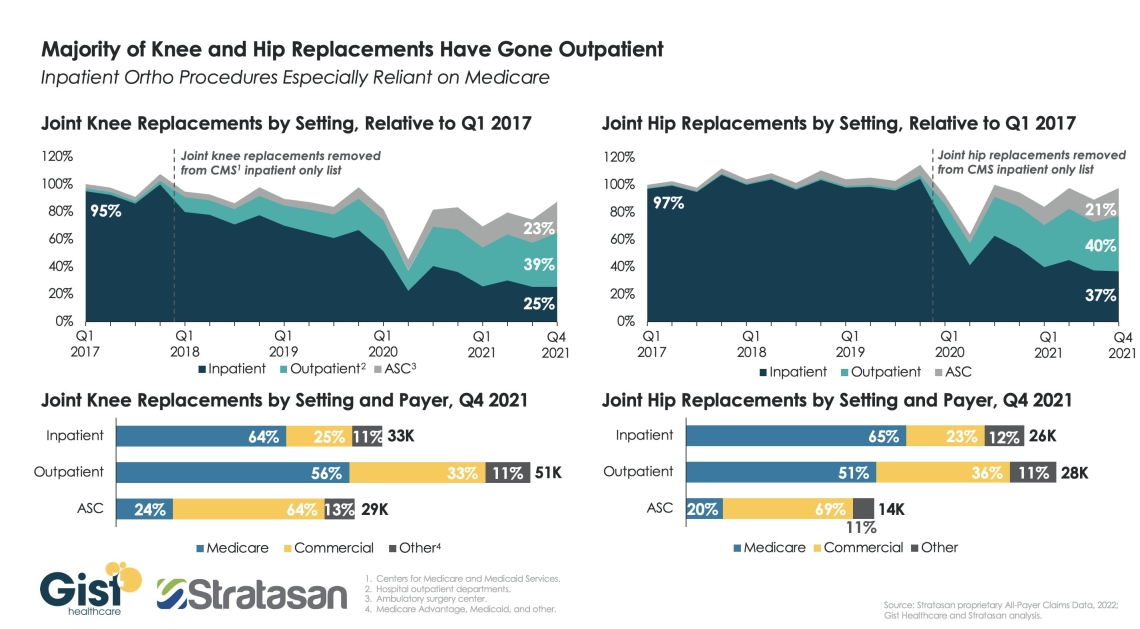
Shifts in Care Setting: Knee and Hip Replacements by Payer, 2017-2021

Key Takeaways From Stratasan and Gist Healthcare (August 2022):

  • Since 2017, high-volume orthopedic procedures, like knee and hip replacement, have gone from being almost entirely in-patient to majority out-patient/ASC.
  • While these care-setting shifts can be attributed in part to COVID, the primary driver is CMS policy change.
  • Q4 2021 data indicates whether patients move to OP or ASC is often determined by payer type. In-patient orthopedic procedures are the most Medicare-reliant, while ASCs are mostly commercial.
  • A once-reliable revenue stream for hospitals and health systems is rapidly changing course. Acute-care providers must adapt to remain financially viable over the long term. 


Outpatient Shift
Data Source: Stratasan's proprietary All-Payer Claims Dataset (for those under 65 years), In-Patient Standard Analytical Files, and Out-Patient Standard Analytic Files. For more executive-level commentary and insights from the week in healthcare from Gist Healthcare, subscribe to The Weekly Gist.

Want to Chat About Challenges in Your Market? Let's Connect.

Request a Call
theme-1

U.S. Health Systems See Declining Volume in Pediatric, Maternal and Newborn Departments, Uptick in Pediatric ICU Visits in June 2021, According to Syntellis Performance Trends Report

A new report from Syntellis Performance Solutions, a leading provider of innovative enterprise performance management software, data and analytics solutions for healthcare organizations, released today reveals that although inpatient volumes are beginning to return to and even surpass pre-pandemic levels, pediatric, maternal and newborn departments lag by 2.9 percent when compared to June 2019.

What is Financial Planning & Analysis (FP&A)?

The Basics of FP&A


What is financial planning & analysis (FP&A)?

FP&A stands for financial planning and analysis. FP&A is the process that a company's finance department uses to perform operational budgeting, strategic financial planning, and forecasting to support organizational operations. FP&A functions can be performed manually, but most companies have adopted purpose-built software — such as enterprise performance management (EPM) solutions — to automate and streamline processes, leverage data from general ledger and other software systems, and expedite decision-making.


What is the purpose of FP&A?

FP&A is a critical and primary function of finance departments. Companies of all sizes need FP&A solutions to manage revenue, expenses and cash flows, measure actuals against forecasts, create financial statements, and provide the C-Suite or Board of Directors the data analysis necessary to set company direction, establish goals, monitor results, and grow profitably. The accuracy and transparency of data are important success factors, which is why more companies rely on FP&A software to gather data, perform calculations, and create reports.


What are best practice principles for financial planning and analysis?

High-performing finance departments that embrace FP&A principles do seven key things:

  1. Streamline and integrate financial planning processes
  2. Integrate data from disparate processes and software systems onto a unified platform
  3. Make data transparent and actionable
  4. Facilitate decision-making by providing relevant data in easy-to-understand formats
  5. Align decisions to budget, goals, and long-term financial plans
  6. Employ driver-based scenario modeling to gauge impact of scenarios
  7. Produce relevant reports easily


What makes a good FP&A professional?

At a minimum, FP&A analysts must have a strong finance and accounting background and data analysis skills. Those looking to improve their FP&A skills or hire someone in FP&A should focus on these vital areas that set leading FP&A analysts apart:

  • Strong communication and collaboration. Good FP&A analysts have strong communication skills and can interpret complex financial data and communicate insights in a language that business stakeholders outside of finance understand. They should recognize what’s most important to the business and tailor reporting to drive collaboration and alignment across the business. They must partner well with other functions across the organization.
  • Strategic mentality – keep up with modern finance. Especially in today’s changing business climate, FP&A leaders need to determine new ways to deliver meaningful, accurate, and timely budgets and reports. They will look to reduce time spent budgeting and creating reports so they can spend more time providing meaningful analysis and recommendations. This requires knowledge of FP&A trends and modern technology to improve financial planning processes.
  • Familiarity with modern financial technology and tools. The FP&A landscape fundamentally changed over the past decade, and FP&A professionals are accustomed to using the latest tools to automate data collection and collation tasks, leaving more time for analysis that can improve business operations. If your organization doesn’t have a modern FP&A software solution, you may have difficulty attracting top talent.

FP&A Software: Beyond Budgeting


What is FP&A software?

FP&A software solutions help organizations modernize key planning and reporting processes to make quicker, data-driven decisions that align to financial and strategic plans and goals. But not all software vendors are created equal. Look for a company with deep expertise in your industry, specialized products designed for the unique needs of your industry, and implementation that includes advice on best practice configurations.

Seek software that meets these requirements:

  • Incorporates data input from source systems across your organization and external data, as required, to empower informed decision-making
  • Supports updating forecasts on the fly to encourage agility and course correction
  • Builds highly formatted financial statements and analytic reports to suit your needs, with appropriate report distribution mechanisms
  • Allows easy and intuitive ad hoc reporting that requires little or no training
  • Includes dashboards with drill-down capability for analysis and data discovery
  • Uses a scenario-based approach to create forward-looking financial statements and financial plans that support an organization’s strategic goals
  • Prioritizes projects and tracks budgets for capital expenditures at the corporate, division, and/or department level


Why modern finance leaders switch from legacy methods to FP&A software

Legacy systems, such as ERP-provided budget solutions and Excel-based approaches, no longer meet the intense modeling and data transparency needs of modern finance departments. Robust FP&A software can provide better:

  • Accuracy: Ensure that your data is up to date and all in one place. Modern budgeting software helps maintain version control and allows access only to authorized users.
  • Speed & efficiency: A leading-edge FP&A software solution will save considerable time on budgeting and reporting processes, allowing quick budgeting pivots when business conditions change.
  • Data integration: A single source of truth can drive unified accountability in data and decision-making, a feature that not all FP&A systems can accomplish.
  • Industry-specific features: FP&A solutions aren’t one-size-fits-all, so look for software designed with your industry in mind. For example, healthcare organizations should seek a solution with cost accounting and contract management capabilities, banks and other financial institutions would need relationship profitability tools, while colleges and universities would prioritize grant planning and commitment planning functionality.

What to Look for in FP&A Software 


6 must-have requirements in Financial Planning and Analysis (FP&A) software

  1. Modern budgeting. Budgeting and forecasting software includes distributed budget inputs, permission-based workflows, and visibility to underlying data — streamlining the budgeting process and financial accountability in ways that Excel can’t touch.
  2. Financial forecasting and scenario analysis. Forecasting tools provide the ability to stay nimble, understand the impact of varying business conditions, model scenarios quickly, and reforecast, when necessary.
  3. Financial reporting. A modern FP&A solution provides a robust collection of standard reports for required financial reporting, budget and forecast reports, validation reports, and profitability analyses; the ability to create ad hoc reports and better communicate through insightful visualizations; and appropriate report distribution mechanisms.
  4. Transparency. FP&A software offers the ability to drill down to the individual account level and produce reports on current data to quickly generate insights, improving efficiency and accountability throughout the organization.
  5. Unified data & solutions. Look for a solution that integrates data from numerous source systems (general ledger, payroll, HR, etc.) onto a single platform to create and monitor budgets and plans, measure profitability, and simplify reporting and analysis.
  6. Cloud hosting & security. Modern solutions are hosted in the cloud to minimize IT support, update seamlessly, comply with SOC 2 security and regulatory requirements, automate data integration, and ensure high performance and reliability, including a disaster recovery plan.
Comprehensive Monitoring for companies looking for FP&A software


Advantages of cloud-based FP&A software and key factors to consider

Not all cloud solutions are the same. Here are the key characteristics to evaluate.

  • Minimal IT footprint. A finance-owned solution gives the department more control and flexibility without reliance on IT resources for installation or ongoing support.
  • Automated data imports and integration. Automatic and secure data import from core software systems (general ledger, payroll, HR, etc.) and full integration on a single platform eliminates manual data uploads, increasing accuracy while allowing more time for value-added analysis.
  • Security. Third-party validation such as SSAE 18 SOC 2 compliance and security integration with existing protocols provide enterprise-level security, governance, and compliance standards that encrypt and protect your data in transit and at rest. A permissions model managed by finance enables users to view only the data they need to see.
  • Scalability. Software functionality should grow and adapt with your organization. Scalable features include the ability to manage planning processes with multiple users, inputs, and approval steps, and a sandbox environment to test new software versions.
  • Auditing. Data transparency is critical to understanding the “why” behind the numbers. Be sure any FP&A software captures all activity, tracks changes to planning and profitability numbers, and makes audit data easy to retrieve.
  • Compliance. A software solution should comply with the applicable regulations for your industry.


What separates leading FP&A software from the rest?

You’ll find a wide range of FP&A software solutions with different price points and value propositions. Look for these differentiators:

  1. Tailored to the unique needs of your industry. A hospital system is nothing like a bank, and each needs configurable software solutions that adapt to individual planning processes while incorporating industry best practices. Banks and credit unions need such FP&A tools as cash flow-based planning, instrument-level matched-term maturity funds transfer pricing, and risk-based profitability analysis. Meanwhile, hospitals and health systems need robust clinical analytics and contract management. It’s extremely valuable for your vendor of choice to have industry experts to support you.
  1. Usability and ease of financial reporting. Budgeting and financial planning tends to be highly collaborative and many participants may not have extensive finance skills. Delivering reports in the terminology of the business can reduce the need for translation and generate more collaborative and transparent conversations.
  1. Focus on true partnership. Transforming performance management and improvement processes isn’t merely a question of technology — it requires teamwork from inside and outside your organization to implement new tools and processes and overcome challenges. A vendor whose solutions are responsible for facilitating all elements of your financial processes should provide more than just technology — they should partner with you to drive success. That means sharing best practices, making recommendations for how to set up systems and processes to fit your unique needs, and offering advice based on deep experience working in and serving your industry. A vendor’s commitment to your shared success will lay the foundation for an ongoing, fruitful partnership.


How to evaluate vendors

Researching potential vendors is just as important as test-driving the software and ensuring it will meet your needs. Put these 4 tasks on your to-do list:

  1. Learn about the vendor’s implementation processes and methodology. Do implementation principals work for the vendor or for a third party? Do they have expertise in leveraging best practices to transform planning processes and financial performance in your industry? Who is responsible if issues arise during/after implementation? The answers to these questions should inform your evaluation of the vendor’s commitment to partnership.
  1. Get references from existing clients similar in size and industry as your company. Ask questions about their implementation experience, ongoing support, and post-implementation support and training.
  1. Look to outside sources for vendor information. Industry analysts can provide unbiased vendor reviews based on standardized rating criteria. Check out reviews from agnostic reviewers and industry-specific associations.
  1. Review information the vendor publishes. You want a vendor that stays current on trends that affect your industry. Look at whether a vendor regularly posts articles and other resources that are relevant to you and your industry, offers market perspectives, and shares information about current events affecting your industry.

A Trusted Leader in FP&A Software


Axiom is the leader in FP&A software for society's most foundational institutions

Not all FP&A software — or vendors — are the same. You want a vendor that is dedicated to your success, with industry-leading solutions, dedicated implementation specialists, and a best practice methodology to take your planning and budgeting processes to the next level.

Syntellis’ Axiom FP&A solutions provide sophisticated, industry-specific software that supports financial planning and reporting on a single, integrated cloud-based platform. We focus exclusively on providing the most robust, innovative enterprise performance management software, data and analytics solutions to healthcare, higher education, and financial institutions.

Start your journey towards helping increase budgeting efficiency and empower goal-based decisions throughout your organization.

Get a demo